Welcome to A Friends Making Machine
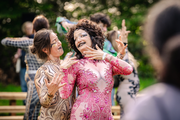
Welcome to the Middelheim Museum! You are standing at the beginning of “A Friend Making Machine,” the first open-air exhibition by Monster Chetwynd!
Monster Chetwynd calls her work a “machine” — but not a machine made of steel or motors. Rather, it is a network of moments. Of encounters. Of doing things together.
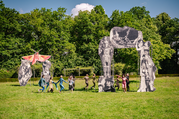
Proscenium Arches, 2026
Already during her university studies, Chetwynd wanted to create a visual tribute to the thinkers who inspired her. Her first collages were playful homages to her textual heroes. For Chetwynd, collage is a way to bring together images, references and stories. Sometimes these remain on paper, but often they take on a spatial form, as in these Proscenium Arches (2026).
In this work you can see Chetwynd’s fascination with theatre and storytelling. She speaks of “exploded theatre”: her installations break open the fixed roles of actors and audience. The choice is yours. Do you step forward and become an actor? Or do you prefer to remain a spectator?
The arches are inspired by the architectural arch that, in a theatre, separates the stage from the auditorium and opens a “window” for the audience. They guide your gaze outward, towards the park, and then back to yourself — much like theatre invites us to reflect on our own role.
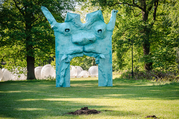
Hellmouth 5, 2025
This giant blue head is part of Thunder, Crackle & Magic, a colourful installation that Chetwynd created for Tate Modern in London. The work is inspired by Mozart’s opera The Magic Flute (1791), in the film version by Ingmar Bergman (1975).
Her series of monumental heads grew out of research into medieval processions and theatre traditions. Christian theatre makers used “Hellmouths”: large stage sets that represented the entrance to hell. HELLMOUTH 5 (2025) refers to this history, to the mythical underworld and to the Roman city gate. Ancient cultures, mythology and science fiction come together here.
The sculpture invites you not only to look, but to walk through it. It recalls a mythological portal, a magical passage into a parallel world. Whoever walks through this work steps into a new possibility, somewhere between childlike imagination and adult experience.
The work is an example of her “impatient sculpture”. Chetwynd does not wait patiently until she finds all the right materials to make the perfect artwork. Instead, she uses simple materials such as wood, cardboard and papier-mâché, bricolaging them into a do-it-yourself gateway.
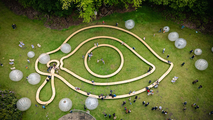
Tears, 2021
The artist aims to set something in motion with her work: she wants to generate new experiences, feelings and meanings. The installation Tears (2021) consists of a giant eye with a tear and rolling Zorbs: human-sized transparent balls that you can climb into and move around in. Visual art comes together here with dance and play.
The rolling balls represent other tears. Are they tears of joy or of sadness? The tension between laughter and crying, between lightness and intensity, gives the work a theatrical dimension. Step into a Zorb yourself and move along — or would you rather just watch?
Through these movements, emotions and interactions, art can create meaning. Tears hold transformation: they move you from one emotional state to another. They are also something pure and universal — the only bodily fluid that is not seen as unpleasant, and one that is recognised as such across all cultures.
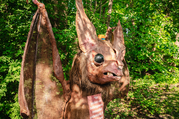
Dragon Island, 2025 & Bats, 2022
- Long Eared Grey Bat, 2022
- Spear Nosed Bat, 2022
- Pollinator Bat, 2022
- Proboscis Nosed Bat, 2022
The colourful work Dragon Island originally formed part of the installation Thunder, Crackle & Magic (2025), just like HELLMOUTH 5 (2025). Here it becomes a habitat for four enlarged bat sculptures.
Bats are often seen as underdogs and are not always appreciated. Yet these dark creatures have something to tell us, Chetwynd believes. That is why she gave these bats T-shirts with climate slogans — an absurd but powerful image of an unexpected messenger. After all, the climate crisis has a direct impact on these animals.
The artist also admires bats for their behaviour. They care well for their young and are essential to the ecosystem. More than five hundred plant species depend on bats for pollination. With their remarkably strong immune systems, bats also show how resilience and care can go together.
Between 2018 and 2022, Chetwynd created a series of bat sculptures as part of the project The Futurology Kiosk. As in her Bat Opera (2003), she worked with recyclable materials, emphasising how reuse and reciprocity can also be artistic principles.
Animals appear frequently in her work. Chetwynd’s salamanders, snails, bats and other creatures are playful yet political. They are hybrid figures that bring together opposites and raise questions about power, care and living together.
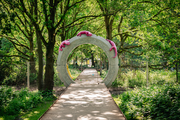
Salamander Portal, 2026
The starting point of this exhibition is the new gateway that Chetwynd created for the museum collection. This striking gate welcomes visitors and sparks their imagination. It connects the museum both physically and symbolically with local residents, patients from the hospital (ZAS Middelheim and the centre for child and adolescent psychiatry UKJA), and students from the University of Antwerp.
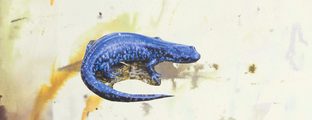
The round stone gateway, with its sculpted patterns, evokes a science-fiction-like fantasy world. It feels as if, with a single step, you enter a world full of new possibilities. Salamanders stand guard here. These animals symbolise resilience and renewal: they can regrow a lost tail, limbs or even organs. Salamanders live both in water and on land. They move easily between two worlds – just as we move between vulnerability and strength.
Chetwynd created this portal in close collaboration with children and young people from UKJA. It shows how carefully the artist attunes her work to the place and context in which it emerges. Like HELLMOUTH 5 (2025), Salamander Portal (2026) is a real passage: an exciting and inviting transition from one place to another.
Since 2023, the hospital, the university and the museum have been working closely together. This collaboration led, among other things, to a new art commission centred on the idea of a gateway. Salamander Portal emerged through an intensive co-creation process with the children and young people of UKJA. They helped shape what they felt was important in a passage between the hospital and the sculpture park.
Inge Glazenmakers is a clinical researcher at ZAS–UKJA and associate professor at CAPRI (Collaborative Antwerp Psychiatric Research Institute) at the University of Antwerp. She closely followed the project:
“We asked the children how this artwork made them feel. One said it made them happy. Another loved the colours, and someone else thought it could include imitation crystals. The salamander especially touched them — a symbol of rebirth and growth. In this way, Chetwynd’s gateway became a shared place where therapy, imagination and the future come together.”
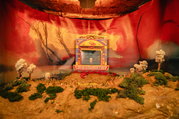
The Movie Palace, 2026
Film plays an important role in Chetwynd’s practice. She doesn’t only make autonomous films, but also records rehearsals during the making process of her performances. Film is also a major source of inspiration for her work, ranging from science fiction to horror. This fascination partly comes from her mother, a well-known set designer.
For this exhibition, Chetwynd created a new film capturing her performances in the sculpture park. In this way, you can experience the live aspect of her work even outside the moment of performance — and continue to feel its energy.
The film is shown through a handmade viewing box, a kind of miniature theatre. This reduced view is a playful nod to theatre practice, where set designers often work with scale models to gain an overview of a stage scene.
Also step inside the library.
For this summer exhibition, Monster Chetwynd delved into the collection of the Middelheim Museum and made a unique selection.
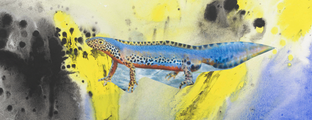
Outdoor Library
Take a seat and immerse yourself in the world of Monster Chetwynd through books that inspired her. Prefer reading in a group? There’s a shared reading session in Dutch every two weeks on Tuesday afternoons.
In addition, our staff has made a carefully curated selection of art books. This way, you can discover the many stories behind the artworks in the museum’s collection.
Shadow Creatures Discovery Lab
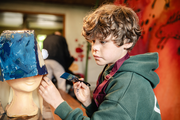
In the imaginative world of Monster Chetwynd, you don’t just look at art — you become part of it. For this exhibition, the artist was inspired by the animals in the park and by the interaction between art and nature.
Moles, bats and salamanders live not only in her work, but also in the Middelheim Museum. These animals are often unfamiliar and therefore not always loved. Completely unfair! In the Shadow Creatures Discovery Lab you discover just how special they are. You don’t just observe, here you can feel, investigate, experiment and create together with others.
Crawl into an imaginary underground world of moles. Discover how a bat finds its way. Make your own colourful salamander head. And join a playful performance with your creations!
At specific times a workshop facilitator will be present (drop-in workshops). No reservation required.
o Atelier Van Lieshout, Franchise Unit
o 16 May-30 June: Wed, Sat & Sun between 13:00-17:00 ⎸July-August: Tue-Sun between 13:00-17:00 ⎸1 September-11 October: Sat & Sun between 13:00-16:00
Visitor Pavilion & Shop
This is the end of the tour. Would you like to see your favorite artwork one last time, or would you rather relax in one of the beach chairs?
For more information about performances and guided tours at this exhibition, please speak to one of our hosts or visit the Visitor Pavilion, stop number 9 on the tour.
You can find the full program on our website: https://middelheimmuseum.be/en/page/programme-exhibition and in our visitor newsletter.
We hope you enjoyed this exhibition!
Imprint & Copyrights
Bio
Monster Chetwynd (b. 1973, London) lives and works in Zurich. Her multifarious practice – spanning interactive performances, film, collage, painting and installation – interweaves elements of folk spectacle, popular culture and surrealistic cinema.
Chetwynd is known for her anarchistic performance pieces, featuring handmade costumes, props and sets. Describing her work as ‘impatiently made’, she often re-uses materials that are easy to process to create ambitious costumes and scenery, while incorporating eclectic cultural references – from Mae West to Vionnet. At the core of Chetwynd’s practice is an emphasis on the work’s collective development.
“When someone knows your name, but you know nothing about them, then this person has some sort of hold over you. An imposed name allowed the exchange to return to me being empowered and so my private first name is protected. I have changed my name each time as an economical way to gain new direction or territory, and it is still working. I am using the name Monster Chetwynd now, and people call me Monster. It is useful, especially on the rare occasion when I need to be controlling or demanding. People seem to get excited and think to themselves, “Here we go, let her rip… yeah, here’s the Monster”, and they are thrilled. I think the name works well because it is genderless, engulfing and inclusive.”
— Monster Chetwynd 2025
Monster Chetwynd
A friend’s making machine’
May 16, 2026 — October 11, 2026
Middelheim Museum
www.middelheimmuseum.be
Curators: Sara Weyns and Pieter Boons
Middelheim Museum Team: Grietje D'Hollander, Jasper De Ridder, Christiaan Huyghe, Rafaëlle Lelièvre, Samuel Pinillos Garcia, An Roels, Erik Rombaut, Eve Van Goey, Caterina Verdickt, Toon Waroux, Floor Wyns.
Special thanks to: The artist and all performers, Sadie Coles HQ, Middelheim Promotors, Opera Ballet Vlaanderen, Marie Van Praag